Cosmetology infection control practice questions
Infection control is the largest single topic on every cosmetology written exam. It sits inside the NIC’s 35% Scientific Concepts domain, takes 28 of 100 scored questions in Texas, and is part of the 30% Safety and Infection Control domain in California.
110 questions in 1 hour 30 minutes in the NIC format. 16 of the 110 questions come from infection control, and every answer is explained.
Or try the free infection control drillWhich of the following is NOT a single-use item?
What to know about infection control
- Three levels of infection control: cleaning (removing visible dirt and debris with soap or detergent and water), disinfection (destroying most microorganisms on nonporous surfaces, but not bacterial spores) and sterilization (destroying all microbial life, spores included). Salons clean and disinfect; sterilization is for medical settings.
- You must clean before you disinfect. Disinfectant cannot work through debris, hair or oil left on a tool.
- Use an EPA-registered disinfectant with demonstrated bactericidal, fungicidal and virucidal efficacy, and follow the label for dilution and contact time. The tool must stay wet with disinfectant for the full contact time.
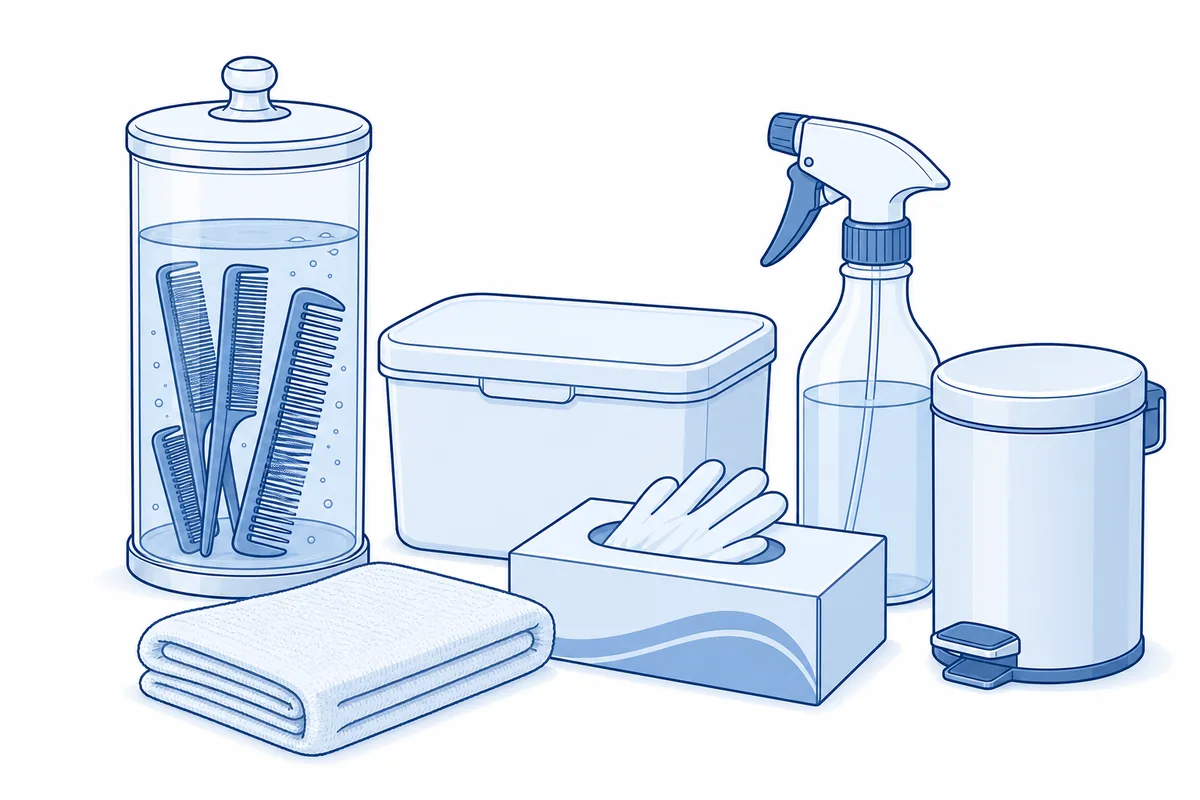
- Multi-use items are hard, nonporous tools that can be cleaned and disinfected (shears, combs, metal pushers). Single-use items are porous or cannot be disinfected (emery boards, buffers, cotton, wooden sticks, neck strips) and are thrown away after one client.
- Disinfectants are for tools and surfaces, never for skin. Antiseptics are for skin.
- Pathogenic bacteria cause disease; nonpathogenic bacteria are harmless or helpful. Cocci are round, bacilli rod-shaped and spirilla spiral. Staphylococci grow in clusters and cause abscesses and boils; streptococci grow in chains.
- HIV, hepatitis B and hepatitis C are bloodborne viruses. Standard Precautions treat all blood and body fluids as potentially infectious.
- Blood exposure during a service: stop the service, put on gloves, clean the injured area, apply an antiseptic and a bandage, then clean and disinfect or discard everything that touched blood (sharps go in a sharps container) before you go on.
- Never service a client with an active contagious condition such as head lice (pediculosis capitis), ringworm (tinea), impetigo or conjunctivitis. Refer the client to a physician.
NIC outline area I.A: 16 of the 110 questions in our NIC-format mock come from this topic. The notes state principles every state shares; state rules are in the Texas, California and Florida guides.
Drill infection control, then sit the full exam
110 questions in 1 hour 30 minutes in the NIC format. 16 of the 110 questions come from infection control, and every answer is explained.
Or try the free infection control drillCommon questions
What is the difference between disinfection and sterilization?
Disinfection destroys most microorganisms on nonporous surfaces but not bacterial spores. Sterilization destroys all microbial life, including spores. Salon tools are disinfected; sterilization is a medical standard.
What should you do if a client is cut during a service?
Stop the service, put on gloves, clean the cut, apply an antiseptic and cover it, then clean and disinfect or discard everything that touched blood before you continue.
110 questions in 1 hour 30 minutes in the NIC format. 16 of the 110 questions come from infection control, and every answer is explained.
Or try the free infection control drillMore cosmetology exam topics
- Safety, chemistry and electricity · 10 of 110
- Anatomy and disorders · 12 of 110
- Hair care, cutting and styling · 30 of 110
- Hair color and chemical services · 20 of 110
- Skin care, hair removal and makeup · 11 of 110
- Nail care and enhancements · 11 of 110
- State laws and rules
Free infection control drill · NIC mock exam · Texas exam · California exam · Florida exam
Original independent practice. Not affiliated with or endorsed by NIC, PSI, Pearson VUE, TDLR, the California Board of Barbering and Cosmetology, the Florida Board of Cosmetology or any state board.