Cosmetology hair color and chemical services practice questions
Chemical services fall inside the NIC’s 45% Hair Care and Services domain. In Florida they are most of the Written Clinical part: hair coloring and lightening is 39% and permanent waving and chemical relaxing 34%. California gives haircoloring 10% and chemical texture services 12%.
110 questions in 1 hour 30 minutes in the NIC format. 20 of the 110 questions come from hair color and chemical services, and every answer is explained.
Or try the free hair color and chemical services drillLena's client has color-treated, somewhat porous hair and wants soft body waves. Which perm type is the most appropriate choice?
What to know about hair color and chemical services
- Level is how light or dark a color is, on a 1 (black) to 10 (lightest blonde) scale; tone is its warmth or coolness.
- The primary colors are red, yellow and blue. Complementary colors sit opposite each other on the color wheel and neutralize each other: violet cancels yellow, blue cancels orange and green cancels red.
- Temporary color coats the cuticle and shampoos out; semi-permanent color uses no developer and lasts several shampoos; demipermanent color uses a low-volume developer; permanent color uses ammonia and developer to lighten and deposit in one step.
- 10-volume developer deposits color with minimal lift; 20-volume is standard for gray coverage and one to two levels of lift; 30- and 40-volume give more lift with more damage.
- Give a patch (predisposition) test 24 to 48 hours before an aniline derivative (oxidation) tint, and a strand test to check timing and result. Never apply color if the patch test is positive.
- Metallic dyes react with hydrogen peroxide and can damage hair. Test for them before a chemical service.
- Permanent waves and thio relaxers break disulfide bonds with ammonium thioglycolate (reduction); the neutralizer re-forms them (oxidation). Hydroxide relaxers break disulfide bonds by lanthionization and cannot be neutralized back to the original bonds.
- Hydroxide relaxers and thio products are not compatible: never apply one over the other.
- Relaxer retouches go on new growth only. Overlapping onto previously relaxed hair causes breakage.
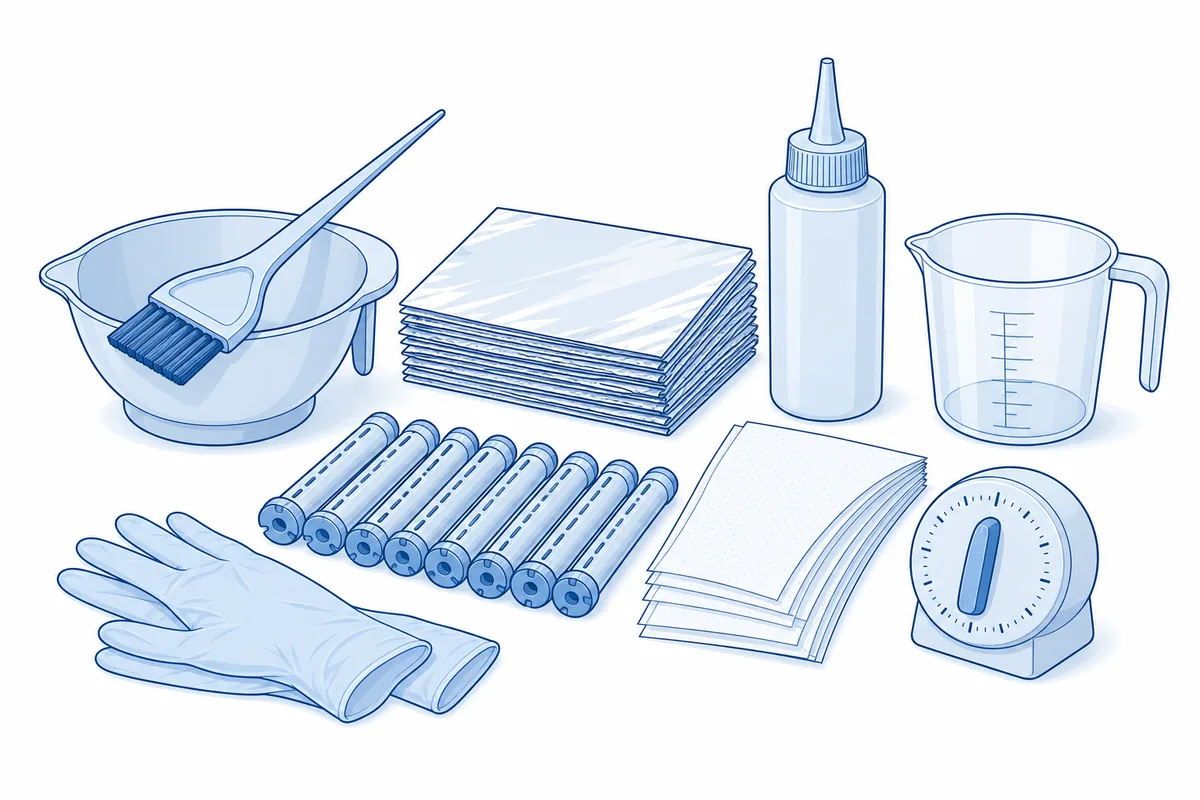
NIC outline area II.E: 20 of the 110 questions in our NIC-format mock come from this topic. The notes state principles every state shares; state rules are in the Texas, California and Florida guides.
Drill hair color and chemical services, then sit the full exam
110 questions in 1 hour 30 minutes in the NIC format. 20 of the 110 questions come from hair color and chemical services, and every answer is explained.
Or try the free hair color and chemical services drillCommon questions
Which color cancels brassy orange tones?
Blue. It sits opposite orange on the color wheel, so a blue-based toner neutralizes orange.
When should a patch test be given?
24 to 48 hours before every application of an aniline derivative (oxidation) tint, even for a returning client.
110 questions in 1 hour 30 minutes in the NIC format. 20 of the 110 questions come from hair color and chemical services, and every answer is explained.
Or try the free hair color and chemical services drillMore cosmetology exam topics
- Infection control · 16 of 110
- Safety, chemistry and electricity · 10 of 110
- Anatomy and disorders · 12 of 110
- Hair care, cutting and styling · 30 of 110
- Skin care, hair removal and makeup · 11 of 110
- Nail care and enhancements · 11 of 110
- State laws and rules
Free hair color and chemical services drill · NIC mock exam · Texas exam · California exam · Florida exam
Original independent practice. Not affiliated with or endorsed by NIC, PSI, Pearson VUE, TDLR, the California Board of Barbering and Cosmetology, the Florida Board of Cosmetology or any state board.