Cosmetology hair care, cutting and styling practice questions
Hair care and services is 45% of the NIC cosmetology theory exam and 40 of the 100 scored questions in Texas. Expect consultation, draping, shampooing, haircutting, wet and thermal styling, braiding, wigs and hair additions.
110 questions in 1 hour 30 minutes in the NIC format. 30 of the 110 questions come from hair care, cutting and styling, and every answer is explained.
Or try the free hair care, cutting and styling drillA guideline that moves as the cut progresses, using a small slice of each previously cut section, is a
What to know about hair care, cutting and styling
- Elevation is the angle at which hair is held from the head while cutting. Zero elevation creates weight and a blunt line; 45 degrees creates a graduated cut with stacked weight; 90 degrees and above remove weight and create layers.
- A stationary guideline stays in one place and all hair is brought to it, which builds length or weight. A traveling guideline moves with each section and creates even layers.
- Fine and thin hair is cut with less texturizing to keep weight; coarse, dense hair often needs thinning or texturizing. Curly hair shrinks as it dries, so leave extra length.
- Drape for the service: a chemical drape uses towels under and over the cape to protect the client from chemicals; a cutting drape uses a neck strip under a cape.
- Thermal tools: test the temperature on a strand or a test cloth before use, keep the comb between the iron and the scalp, and use lower heat on fine, lightened or damaged hair.
- Pin curls have a base, a stem and a circle. The stem controls direction and movement: a no-stem curl gives the most firmness, a full-stem curl the most mobility.
- Rollers set on base give the most volume, half off base medium volume, and off base the least volume.
- Human hair wigs can be colored and heat styled like natural hair; synthetic wigs usually cannot take heat unless the label says heat resistant. Hair additions are applied by taping, bonding, fusion, sewing or linking, and each method has its own removal.
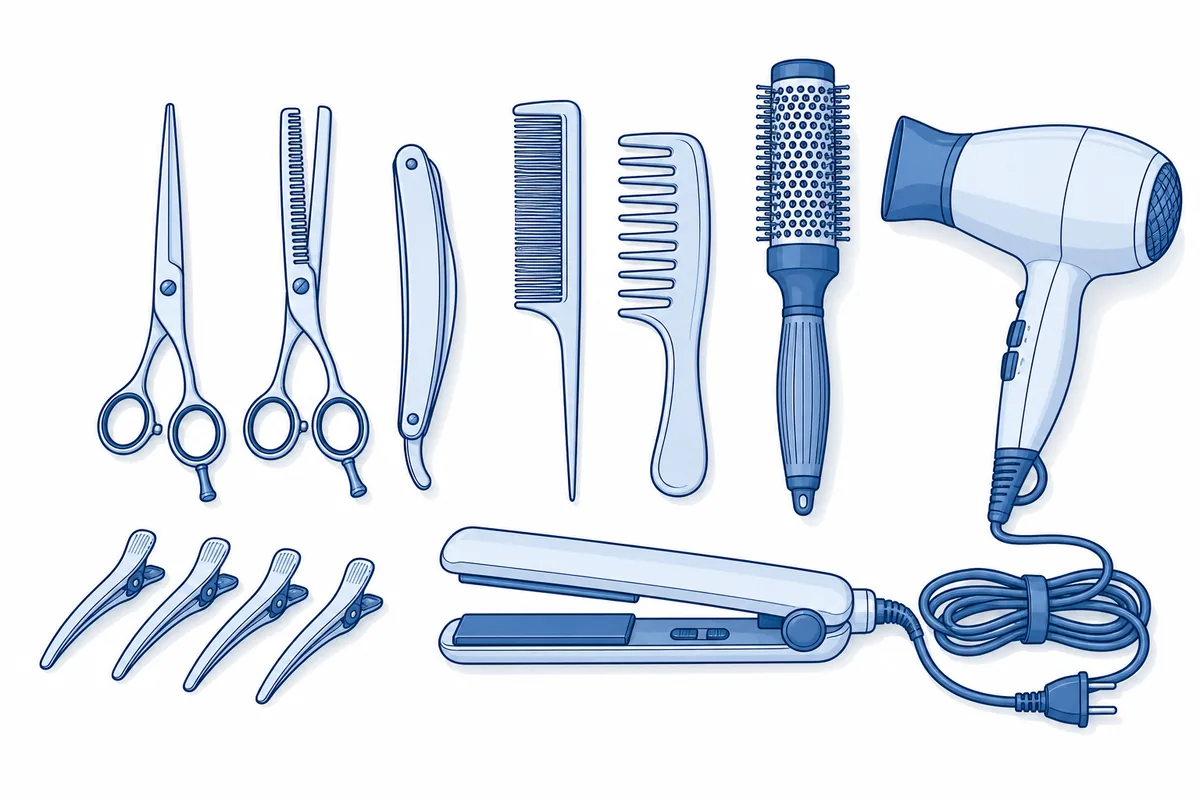
NIC outline area II.A–D: 30 of the 110 questions in our NIC-format mock come from this topic. The notes state principles every state shares; state rules are in the Texas, California and Florida guides.
Drill hair care, cutting and styling, then sit the full exam
110 questions in 1 hour 30 minutes in the NIC format. 30 of the 110 questions come from hair care, cutting and styling, and every answer is explained.
Or try the free hair care, cutting and styling drillCommon questions
What elevation creates a blunt haircut?
Zero elevation: the hair is combed straight down and cut without lifting, which keeps all the weight at the perimeter.
What is a traveling guideline?
A guideline that moves with each new section. Each section uses part of the previous one as its guide, which creates even layers.
110 questions in 1 hour 30 minutes in the NIC format. 30 of the 110 questions come from hair care, cutting and styling, and every answer is explained.
Or try the free hair care, cutting and styling drillMore cosmetology exam topics
- Infection control · 16 of 110
- Safety, chemistry and electricity · 10 of 110
- Anatomy and disorders · 12 of 110
- Hair color and chemical services · 20 of 110
- Skin care, hair removal and makeup · 11 of 110
- Nail care and enhancements · 11 of 110
- State laws and rules
Free hair care, cutting and styling drill · NIC mock exam · Texas exam · California exam · Florida exam
Original independent practice. Not affiliated with or endorsed by NIC, PSI, Pearson VUE, TDLR, the California Board of Barbering and Cosmetology, the Florida Board of Cosmetology or any state board.