Valuation and appraisal
Valuation is Pearson VUE area III with 11 questions and 8% of PSI exams. Expect definitions of value, the principles that move it, the steps of an appraisal and short calculations with the cost and income approaches.
80 questions in 2 hours 30 minutes, 56 to pass. 11 of the 80 questions come from valuation and appraisal, and every answer is explained.
Or try the free valuation and appraisal drillA developer buys three adjoining lots worth $80,000 each and combines them into one parcel worth $300,000. The increase in value from combining them is called
What to know about valuation and appraisal
- Market value is the most probable price a property should bring in a competitive, open market with informed, unpressured parties. Market price is what it actually sold for; cost is what it took to build. The three can differ.
- Value needs DUST: demand, utility, scarcity and transferability.
- Principles of value: substitution (a buyer pays no more than the cost of an equally desirable substitute; the basis of the sales comparison approach), highest and best use (the legal, physically possible, financially feasible, most productive use), conformity, contribution (a feature is worth what it adds, not what it cost), anticipation, regression and progression (a house takes on value from its neighbors), supply and demand, competition, change, and plottage (assembling parcels raises total value).
- The appraisal process: define the problem, plan, collect and analyze data, apply the three approaches, reconcile and report. Appraisers for federally related transactions must be state licensed or certified and follow USPAP; FIRREA (1989) set this up and the Appraisal Foundation writes the standards.
- Sales comparison approach: adjust the comparables, never the subject. If the comparable is better, subtract; if worse, add. Used for homes and land.
- Cost approach: land value plus reproduction (exact replica) or replacement (same utility) cost new, minus depreciation. Depreciation types: physical deterioration, functional obsolescence (poor design, outdated features) and external (economic) obsolescence, which is always incurable because it comes from outside the property. Best for new or special-purpose buildings.
- Income approach: Value = Net operating income ÷ capitalization rate. NOI is potential gross income minus vacancy and collection loss (effective gross income) minus operating expenses, before debt service and depreciation. A higher cap rate means a lower value.
- Gross rent multiplier = sale price ÷ monthly gross rent (homes); gross income multiplier uses annual income (commercial). Reconciliation weights the approaches; it never averages them.
- A comparative market analysis (CMA) and a broker price opinion (BPO) are not appraisals; licensees prepare them to help set a price, and some states require a disclaimer.
- Assessed value is set by the taxing authority for property tax; an equalization factor adjusts assessments between districts.
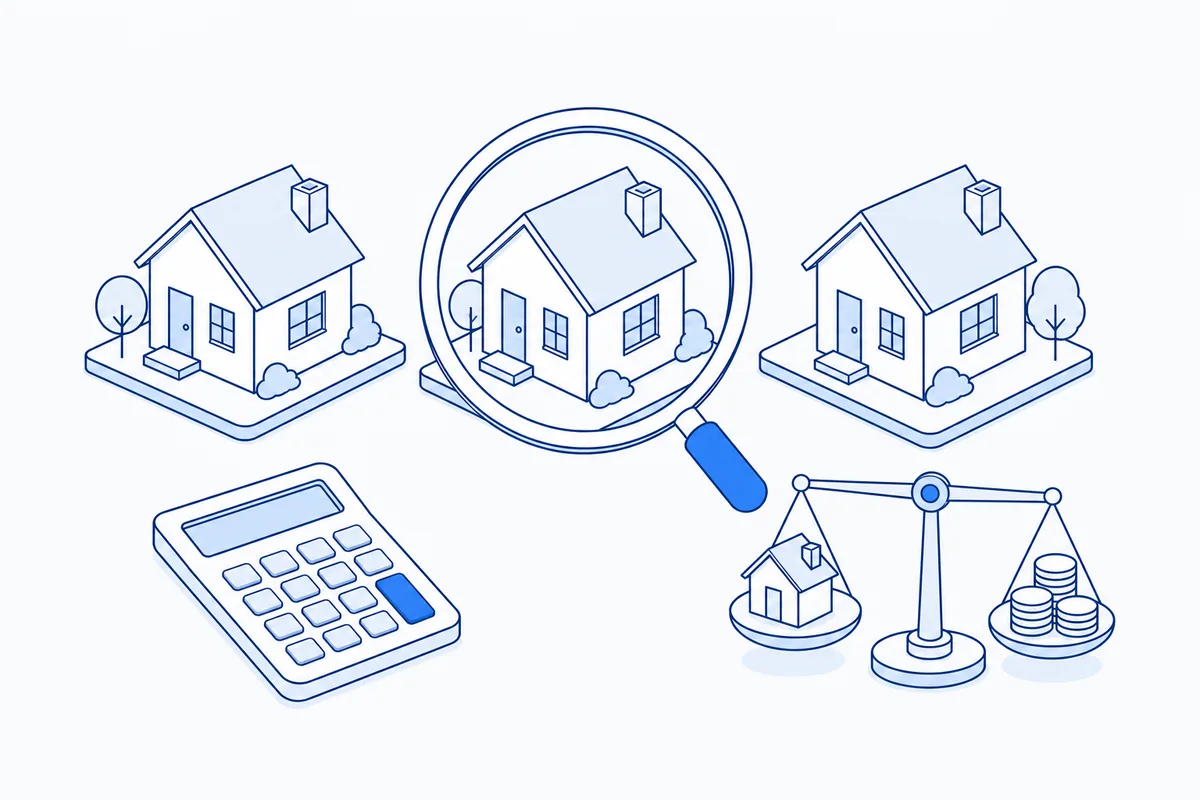
Pearson VUE outline area III: 11 of the 80 scored national questions in our mock come from this topic. The notes state principles that hold in every state; state-specific rules are in the California, Texas and Florida guides.
Drill valuation and appraisal, then sit the full exam
80 questions in 2 hours 30 minutes, 56 to pass. 11 of the 80 questions come from valuation and appraisal, and every answer is explained.
Or try the free valuation and appraisal drillCommon questions
Which type of depreciation is always incurable?
External (economic) obsolescence, because its cause lies outside the property lines, such as a new highway or a declining neighborhood. Physical deterioration and functional obsolescence can be curable or incurable.
How do you find value with the income approach?
Divide net operating income by the capitalization rate. A building with $60,000 NOI at an 8% cap rate is worth $750,000. If the cap rate rises, the value falls.
80 questions in 2 hours 30 minutes, 56 to pass. 11 of the 80 questions come from valuation and appraisal, and every answer is explained.
Or try the free valuation and appraisal drillMore real estate exam topics
- Property ownership and estates · 9 of 80
- Legal descriptions and land use controls · 6 of 80
- Contracts · 9 of 80
- Agency · 7 of 80
- Practice of real estate and fair housing · 10 of 80
- Property disclosures and environmental issues · 9 of 80
- Financing and settlement · 7 of 80
- Transfer of title · 5 of 80
- Real estate math · 7 of 80
Free valuation and appraisal drill · National mock exam · California exam · Texas exam · Florida exam
Original independent practice. Not affiliated with or endorsed by Pearson VUE, PSI or any state real estate commission.