Transfer of title
Transfer of title is Pearson VUE area II.B (4 questions) and 6% of PSI exams, and it pairs with ownership and recording concepts across the outline. Learn the deed elements, the deed types and how recording protects a buyer.
80 questions in 2 hours 30 minutes, 56 to pass. 5 of the 80 questions come from transfer of title, and every answer is explained.
Or try the free transfer of title drillA slow-moving river deposits silt along the Nguyens' riverfront lot year after year, adding several feet of dry land. The added land is an example of
What to know about transfer of title
- A valid deed needs a competent grantor, an identifiable grantee, words of conveyance (granting clause), a recital of consideration, a legal description, the grantor’s signature, and delivery and acceptance. Title passes on delivery, not on recording. Acknowledgment before a notary is required to record the deed, not for validity.
- Deed types: general warranty (the broadest promises: seisin, right to convey, against encumbrances, quiet enjoyment, further assurance and warranty forever, covering the whole chain), special warranty (warrants only the grantor’s own period of ownership), bargain and sale (implies ownership, no warranties), quitclaim (no warranties, conveys whatever interest the grantor has; used to clear clouds on title), and deeds by officers such as sheriff’s, trustee’s and tax deeds.
- Voluntary alienation is transfer by the owner’s act: sale, gift, dedication to the public, or will. A person who dies with a will is testate (real property passes by devise to a devisee); without a will, intestate, and the state’s law of descent decides. Probate proves the will and settles the estate.
- Involuntary alienation happens without the owner’s consent: descent, escheat to the state, eminent domain, foreclosure, partition of co-owners, adverse possession and natural forces (accretion adds soil gradually, erosion removes it, avulsion is a sudden loss, reliction is land exposed by receding water).
- Adverse possession ripens into title when possession is open and notorious, continuous for the statutory period, hostile (without permission), actual and exclusive; the period varies by state, and some states also require color of title or payment of taxes.
- Recording gives constructive notice to the world; actual notice is what a person actually knows or has seen. An unrecorded deed is valid between the parties but may lose to a later good-faith purchaser who records first.
- The chain of title traces ownership through the public record; an abstract summarizes it; a title search finds gaps and clouds. Marketable title is free of reasonable doubt; a quiet title action asks a court to remove a cloud.
- Title insurance protects against defects in the record and unknown liens: an owner’s policy for the purchase price, a lender’s policy for the loan balance (declining as it is paid). Standard policies exclude defects a survey or inspection would reveal, unless an extended policy is bought. A title commitment is issued before closing and the policy after.
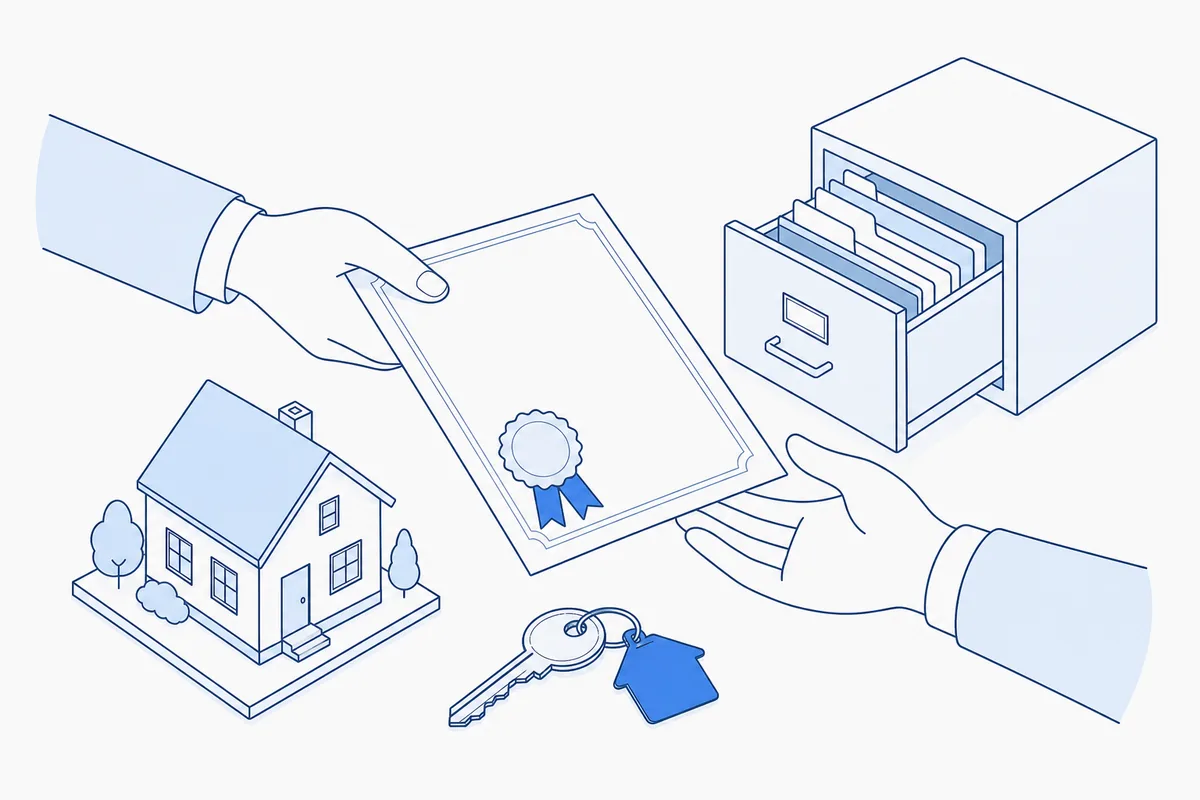
Pearson VUE outline area II.B: 5 of the 80 scored national questions in our mock come from this topic. The notes state principles that hold in every state; state-specific rules are in the California, Texas and Florida guides.
Drill transfer of title, then sit the full exam
80 questions in 2 hours 30 minutes, 56 to pass. 5 of the 80 questions come from transfer of title, and every answer is explained.
Or try the free transfer of title drillCommon questions
When does title pass under a deed?
When the deed is delivered by the grantor and accepted by the grantee, during the grantor’s lifetime. Recording is not required for the transfer to be valid, but it gives constructive notice and protects the grantee against later claims.
Which deed gives the buyer the most protection?
A general warranty deed. The grantor warrants title against defects arising at any time, including before the grantor owned the property, through the covenants of seisin, right to convey, against encumbrances, quiet enjoyment, further assurance and warranty forever.
80 questions in 2 hours 30 minutes, 56 to pass. 5 of the 80 questions come from transfer of title, and every answer is explained.
Or try the free transfer of title drillMore real estate exam topics
- Property ownership and estates · 9 of 80
- Legal descriptions and land use controls · 6 of 80
- Valuation and appraisal · 11 of 80
- Contracts · 9 of 80
- Agency · 7 of 80
- Practice of real estate and fair housing · 10 of 80
- Property disclosures and environmental issues · 9 of 80
- Financing and settlement · 7 of 80
- Real estate math · 7 of 80
Free transfer of title drill · National mock exam · California exam · Texas exam · Florida exam
Original independent practice. Not affiliated with or endorsed by Pearson VUE, PSI or any state real estate commission.