PLAB 1 Neurosciences and Senses (Including Skin) Practice Questions
One of the ten areas in your GMC result · 76 practice questions with answers
180 questions across all ten areas in 3 hours, with a score for neurosciences and senses so you know where you stand.
Free neurosciences and senses drillA 74-year-old woman has a 2-week history of a new right temporal headache, scalp tenderness when brushing her hair and jaw pain when chewing. She has no visual symptoms. Her ESR is 78 mm/hour and CRP is 64 mg/L. What is the most appropriate management?
Neurosciences and Senses (Including Skin) on PLAB 1
Neurosciences and senses is a wide area: neurology and neurosurgery, plus the eye, ear, nose and throat, and the skin. Questions test whether you can separate a dangerous headache or eye problem from a benign one, and manage stroke, seizures and head injury the way UK guidance says.
- In your GMC result
- Your percentage correct in neurosciences and senses (including skin), next to the average for all candidates
- On our mock exam
- 22 of 180 questions, with your percentage for this area in the result
- Our drill
- 10 questions from 76 neurosciences and senses questions, untimed, an explanation after every answer; one free attempt, unlimited with a pass
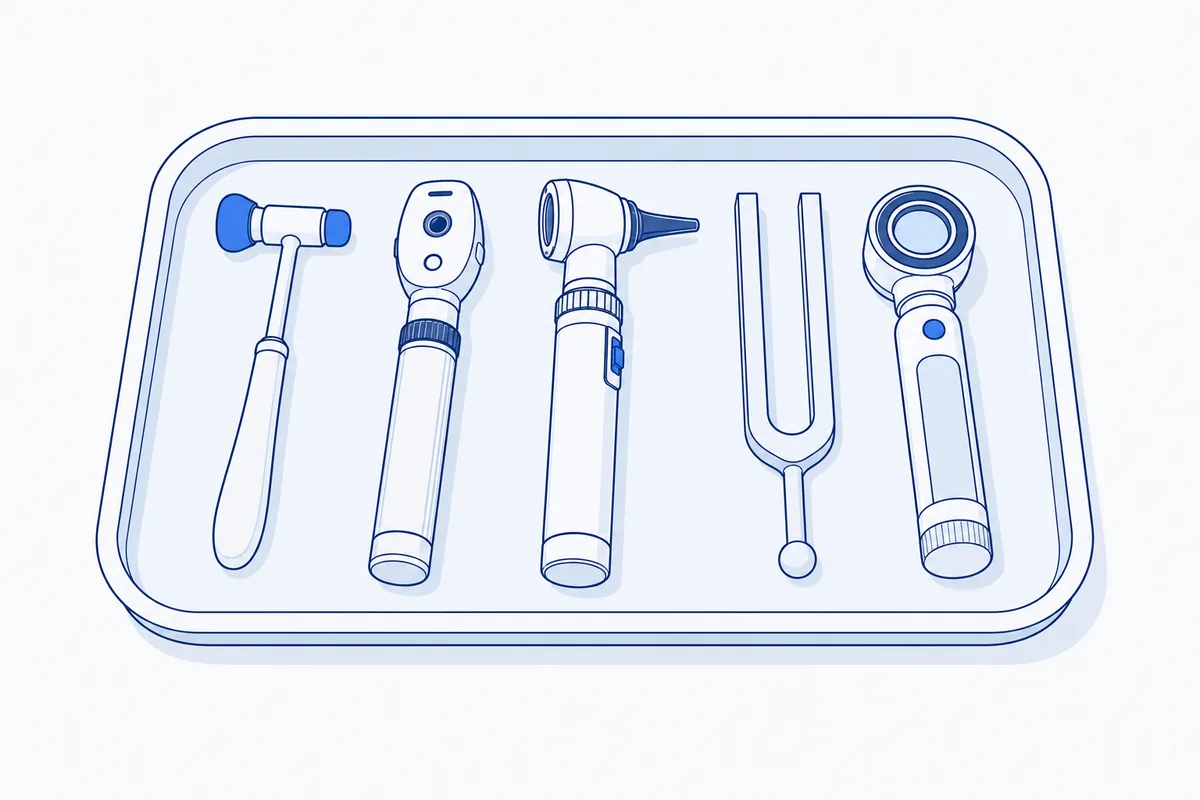
What neurosciences and senses questions test
- Stroke and TIA: recognising them, thrombolysis and thrombectomy windows, imaging and secondary prevention
- Headache: subarachnoid haemorrhage, meningitis, giant cell arteritis, migraine and medication-overuse headache
- Seizures and epilepsy: status epilepticus, first-seizure management, antiseizure drugs and driving rules
- Head and spinal injury: CT head criteria, raised intracranial pressure and cauda equina syndrome
- Eye, ear, nose and throat: the red eye, sudden loss of vision, otitis media, epistaxis, tonsillitis and neck lumps
- Skin: eczema, psoriasis, cellulitis, skin cancer recognition and referral, drug reactions and burns
Sit the full 180 questions under the real clock
180 questions across all ten areas in 3 hours, with a score for neurosciences and senses so you know where you stand.
Free neurosciences and senses drillHow to revise it
- Learn red flags for headache, back pain, visual loss and hearing loss. Questions often ask which patient needs same-day action.
- Use the NICE head injury criteria for CT; they are exact and often tested.
- For skin, revise by description. PLAB 1 describes lesions in words, so learn the words that point to each diagnosis.
Common questions
Why are skin, eyes and ENT in the same area as neurology?
The GMC groups PLAB 1 questions into ten feedback areas based on the MLA content map, and one of them is neurosciences and senses (including skin). Your result shows your percentage correct in this area alongside the other nine.
Does PLAB 1 test DVLA rules?
Questions can ask what you must tell a patient about driving after a seizure, stroke or other condition, and when a doctor may tell the DVLA. These follow the DVLA guidance and the GMC confidentiality guidance.
180 questions across all ten areas in 3 hours, with a score for neurosciences and senses so you know where you stand.
Free neurosciences and senses drillThe other PLAB 1 areas
Sources
- GMC: What is the PLAB 1 exam? (180 questions, three hours, five options)
- GMC: PLAB 1 results (scoring, ten feedback areas, Angoff pass mark, exam and result dates)
- GMC: When and where can I take PLAB 1?
- GMC: Booking a PLAB 1 place (eligibility, attempt limit)
- GMC: Fees for doctors (PLAB fees from 1 April 2026)
- GMC: Additional PLAB 1 attempt
- GMC: Recent pass rates for PLAB 1 and PLAB 2
- GMC: MLA content map (September 2026)
- GMC: Changes to PLAB 1 in 2027
Original practice questions for exam preparation, written to the GMC’s MLA content map (September 2026) and current UK guidance. Independent practice, not affiliated with or endorsed by the General Medical Council (GMC). Follow current national and local guidance in clinical practice.