PLAB 1 Endocrine, Metabolic and Clinical Haematology Practice Questions
One of the ten areas in your GMC result · 70 practice questions with answers
180 questions across all ten areas in 3 hours, with a score for endocrine and haematology so you know where you stand.
Free endocrine and haematology drillA 71-year-old man with type 2 diabetes treated with insulin is on a surgical ward. A nurse finds him sweaty and shaky but alert and able to swallow safely. His capillary glucose is 3.1 mmol/L. What is the most appropriate initial treatment?
Endocrine, Metabolic and Clinical Haematology on PLAB 1
Endocrine, metabolic and clinical haematology covers the conditions that show up as abnormal blood results: high or low glucose, sodium, potassium and calcium, abnormal thyroid tests, anaemia and clotting problems. Questions test whether you can interpret the result, spot the emergency and treat it safely.
- In your GMC result
- Your percentage correct in endocrine, metabolic and clinical haematology, next to the average for all candidates
- On our mock exam
- 20 of 180 questions, with your percentage for this area in the result
- Our drill
- 10 questions from 70 endocrine and haematology questions, untimed, an explanation after every answer; one free attempt, unlimited with a pass
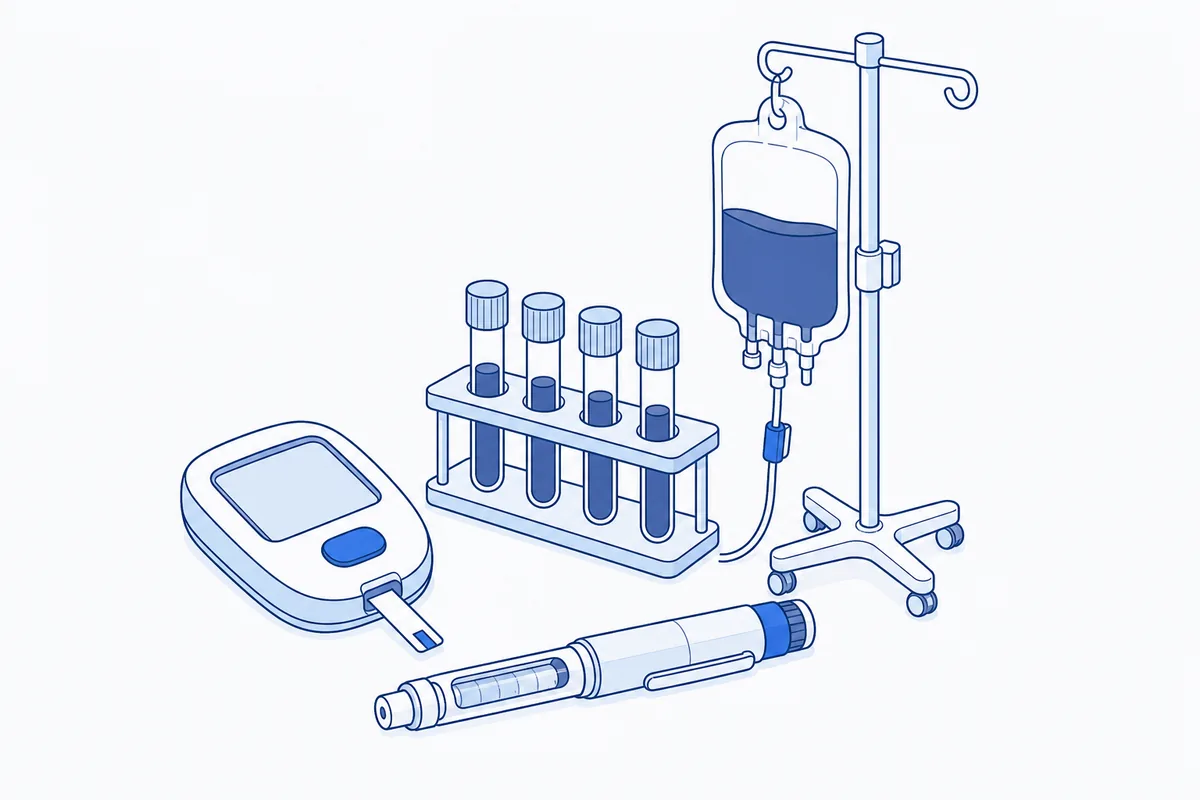
What endocrine and haematology questions test
- Diabetes: diagnosis, type 2 drug choices, insulin safety, hypoglycaemia, diabetic ketoacidosis and the hyperosmolar hyperglycaemic state
- Thyroid, adrenal and pituitary disease: hypo- and hyperthyroidism, Addison disease and adrenal crisis, Cushing syndrome, prolactinoma
- Electrolytes: hyponatraemia, hyperkalaemia, hypercalcaemia and their emergency treatment
- Anaemia: iron deficiency, B12 and folate deficiency, haemolysis, and when to refer
- Haemostasis and anticoagulation: warfarin and DOAC reversal, heparin, bleeding disorders and thrombophilia
- Transfusion and haematological cancer: transfusion reactions, sickle cell crisis, leukaemia, lymphoma and myeloma
Sit the full 180 questions under the real clock
180 questions across all ten areas in 3 hours, with a score for endocrine and haematology so you know where you stand.
Free endocrine and haematology drillHow to revise it
- Make a one-page table of each electrolyte emergency: the threshold, the first treatment and the drug dose from the BNF.
- Work through blood results in a fixed order (haemoglobin, MCV, white cells, platelets, then chemistry) so the pattern points to the diagnosis.
- Learn the sick-day rules for steroids, insulin and metformin; they are common prescribing questions.
Common questions
Do I need to know drug doses for PLAB 1?
For common emergencies, yes. Questions on hypoglycaemia, hyperkalaemia, adrenal crisis and anticoagulant reversal can turn on the right drug and route. Learn them from the BNF, which is the UK reference.
Which units are used?
UK units: glucose in mmol/L, haemoglobin in g/L, and white cells and platelets ×10⁹/L. Our questions use the same units as PLAB 1.
180 questions across all ten areas in 3 hours, with a score for endocrine and haematology so you know where you stand.
Free endocrine and haematology drillThe other PLAB 1 areas
Sources
- GMC: What is the PLAB 1 exam? (180 questions, three hours, five options)
- GMC: PLAB 1 results (scoring, ten feedback areas, Angoff pass mark, exam and result dates)
- GMC: When and where can I take PLAB 1?
- GMC: Booking a PLAB 1 place (eligibility, attempt limit)
- GMC: Fees for doctors (PLAB fees from 1 April 2026)
- GMC: Additional PLAB 1 attempt
- GMC: Recent pass rates for PLAB 1 and PLAB 2
- GMC: MLA content map (September 2026)
- GMC: Changes to PLAB 1 in 2027
Original practice questions for exam preparation, written to the GMC’s MLA content map (September 2026) and current UK guidance. Independent practice, not affiliated with or endorsed by the General Medical Council (GMC). Follow current national and local guidance in clinical practice.