Paramedic practice test · 8–12% of the exam
Paramedic Airway, Respiration and Ventilation
Airway, Respiration and Ventilation is 8–12% of the paramedic exam. The test plan samples assessment, pathophysiology and management, so a typical item gives you a breathing patient with vital signs, lung sounds and a capnography reading and asks what is wrong or what to do next.
150 questions in 3 hours 30 minutes, weighted to the six official domains, with a score report by domain and topic and an explanation for every answer.
Or start with a free domain drillA 30-year-old man was found apneic after taking methadone. After naloxone and bag-mask ventilation, he is now breathing 14 times per minute and is alert, and he wants to refuse transport. What pharmacologic concern should the paramedic explain?
What the Airway, Respiration and Ventilation domain tests
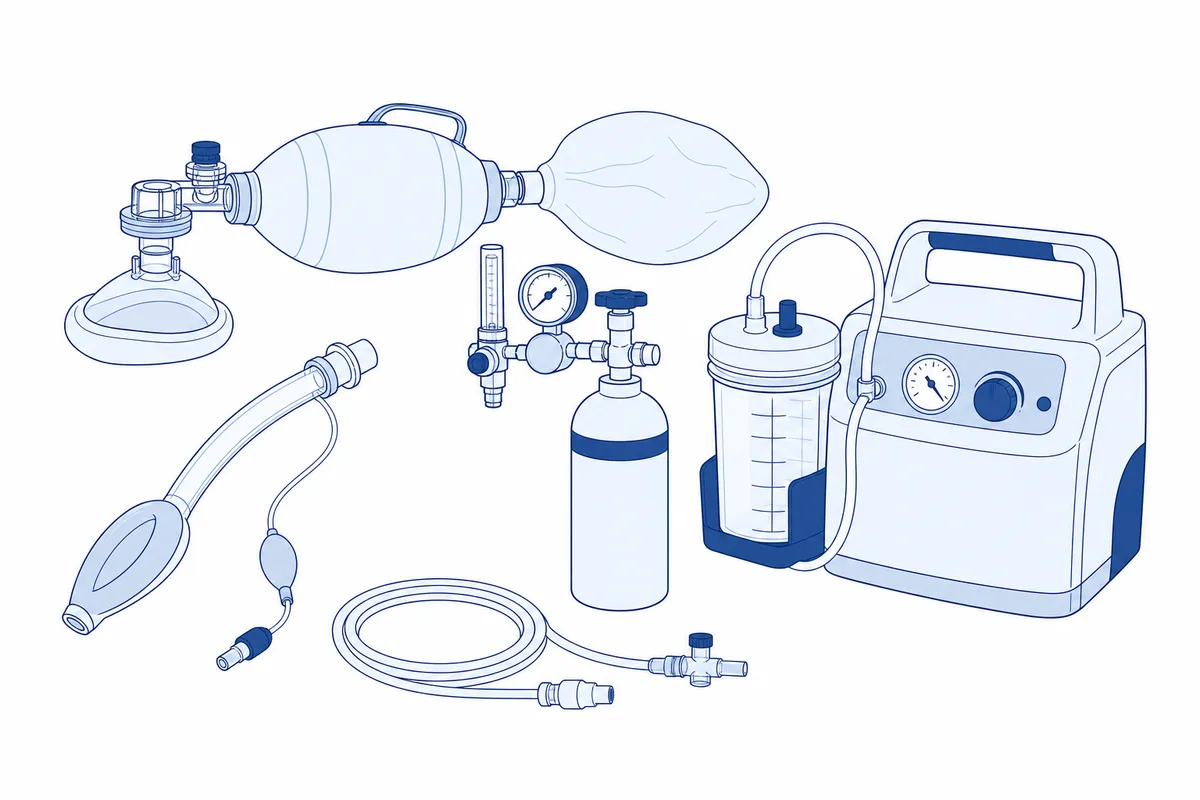
At the paramedic level the management questions reach the full airway ladder: positioning and adjuncts, two-person BVM, supraglottic airways, endotracheal intubation confirmed with waveform capnography, troubleshooting a ventilated patient, CPAP, needle decompression and the surgical airway.
- Assessment: adequate versus inadequate breathing, work of breathing, lung sounds and what each means, capnography waveforms, the limits of pulse oximetry.
- Pathophysiology: asthma, COPD, pneumonia, pulmonary embolism, pneumothorax, pulmonary edema, anaphylaxis, opioid respiratory depression, upper versus lower airway obstruction.
- Management: BVM technique, supraglottic placement and confirmation, tube confirmation and DOPE troubleshooting, right-mainstem recognition, CPAP indications and contraindications, suctioning, oxygen titration, ventilation rates.
- Procedures: needle decompression indications, surgical airway indications, tracheostomy problems.
- Pediatric airway: anatomic differences, croup, epiglottitis, bronchiolitis, early respiratory failure, BVM volumes.
- Respiratory pharmacology: albuterol and ipratropium, magnesium for severe asthma, epinephrine for anaphylaxis and croup.
In our 150-question practice exam this domain gets 14 questions, the middle of its official 8–12% range.
Know these cold
- Waveform capnography is the standard for confirming and monitoring an endotracheal tube; a lost waveform means check the tube first.
- DOPE for a deteriorating ventilated patient: Displacement, Obstruction, Pneumothorax, Equipment.
- Ventilate an adult with an advanced airway once every 6 seconds; avoid hyperventilation, which lowers venous return and cerebral blood flow.
- Titrate oxygen to SpO2 94–98% for most patients and 88–92% for chronic CO2 retainers; pulse oximetry reads falsely normal in carbon monoxide poisoning.
- CPAP is for the awake, cooperative patient who can protect the airway, such as pulmonary edema or COPD exacerbation; not for apnea, vomiting, hypotension or facial trauma.
- Needle decompression for tension pneumothorax goes at the second intercostal space midclavicular or the fourth or fifth intercostal space anterior axillary.
- Severe asthma: albuterol 2.5 mg and ipratropium 0.5 mg nebulized, epinephrine IM for the patient who cannot move air, magnesium sulfate 2 g IV.
Common questions
Does the paramedic exam ask about RSI drugs?
Rapid sequence intubation is not part of every state’s paramedic scope, and the drugs and doses vary by protocol, so we do not test them. We test what is national: tube confirmation with waveform capnography, troubleshooting a ventilated patient, when to decompress a chest and when a surgical airway is indicated.
How are pediatric airway questions different?
Children have a larger occiput and tongue, a more anterior larynx and a narrower airway, so positioning, adjunct sizing and gentle BVM volumes matter more. Expect croup versus epiglottitis versus foreign body, bronchiolitis in infants and the early signs of respiratory failure before arrest.
Ready for exam day?
150 questions in 3 hours 30 minutes, weighted to the six official domains, with a score report by domain and topic and an explanation for every answer.
Or start with a free domain drillThe other Paramedic domains
- Cardiology and Resuscitation 10–14%
- Trauma 6–10%
- Medical, Obstetrics and Gynecology 24–28%
- EMS Operations 8–12%
- Clinical Judgment 34–38%
Domain weights and knowledge areas from the National Registry Paramedic Examination Specifications (July 2024). National Registry: AEMT and Paramedic Certification Examinations · National Registry Paramedic Examination Specifications (test plan, July 1, 2024).
Original independent practice questions. Not affiliated with or endorsed by the National Registry of Emergency Medical Technicians. Follow your local protocols and medical director in the field.