GC Evaluation Practice Questions
About a sixth of the GC exam: assessing the patient before treatment, knowing the anatomy you chart, documenting care and recognizing medical emergencies.
Ten GC questions on evaluation, with an explanation after each answer. Your first attempt is free.
Or take the full 95-question GC practice exam- 45 original Evaluation questions, each answer explained
- 17% of the GC exam, about 16 of 95 questions
- Domain I of DANB’s GC outline, effective July 1, 2022
A normal adult respiration rate at rest is about:
What the Evaluation domain covers
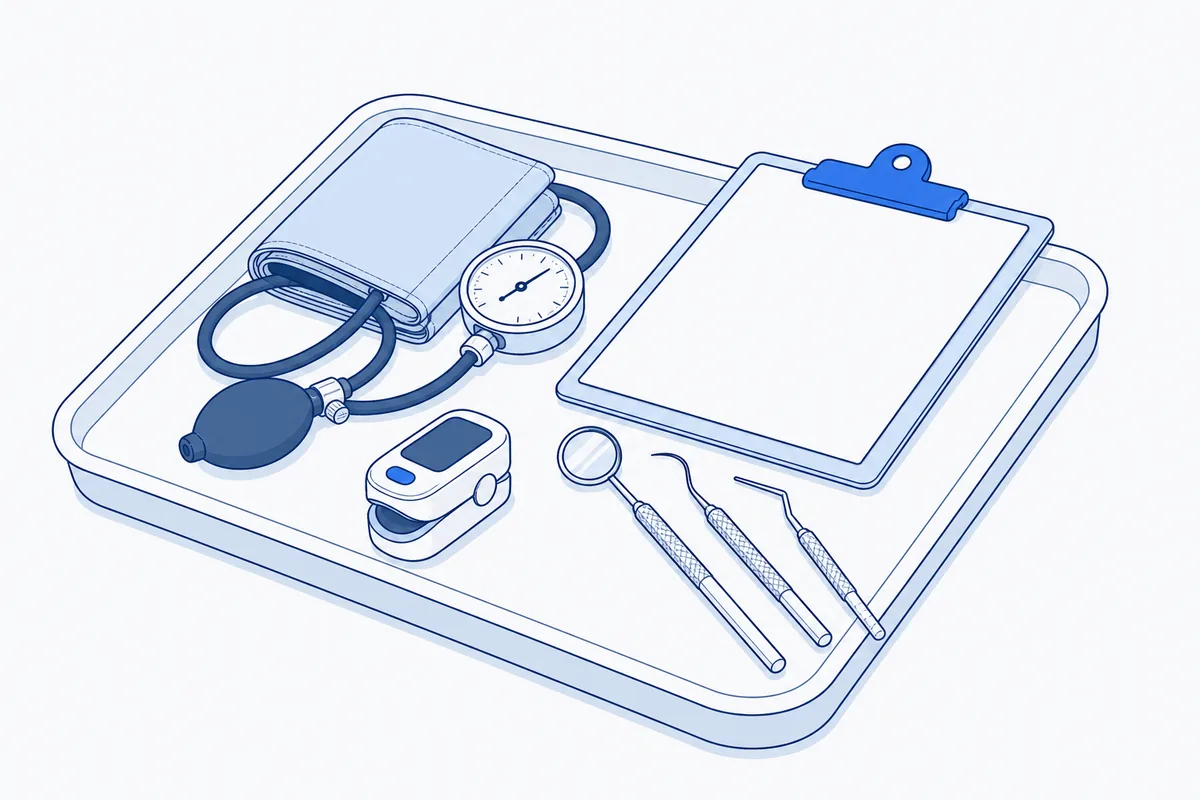
- Preliminary exam: general physical condition, vital signs, health and dental histories and diagnostic data
- Head, neck and oral cavity: tooth anatomy, arches, functions, surfaces, angles and divisions, occlusion and malocclusion, circulatory, lymphatic, muscular, skeletal and nervous systems
- Charting conditions of the oral cavity
- Treatment documentation: treatment and prescriptions, consent and patient compliance
- Medical conditions that can cause emergencies: syncope, seizures, stroke, allergic reactions, asthma, COPD, heart disease, diabetes and hypoglycemia
This list is our own summary. DANB publishes the full outline, references and acronym list in its GC Exam Outline and References.
Drill evaluation, then sit the full exam
Ten GC questions on evaluation, with an explanation after each answer. Your first attempt is free.
Or take the full 95-question GC practice examIdeas the questions test most
- Normal adult pulse is 60 to 100 beats per minute; respirations 12 to 20 per minute.
- Black’s classes: I pits and fissures, II posterior proximal, III anterior proximal, IV anterior proximal with the incisal angle, V cervical third, VI incisal edges and cusp tips.
- Angle Class I: the maxillary first molar’s mesiobuccal cusp sits in the mandibular first molar’s buccal groove.
- Syncope is the most common office emergency; epinephrine treats anaphylaxis; nitroglycerin treats angina; sugar treats a conscious hypoglycemic patient.
- Correct a paper chart with a single line, the date and your initials; never erase.
Start the free Evaluation drill · GC mixed drill · Full 95-question GC practice exam
Common questions
Which medical emergencies are on the GC exam?
DANB’s GC outline lists neurological disorders (syncope, hyperventilation, seizure, stroke), allergic reactions, respiratory disorders (asthma, COPD), cardiovascular disease (heart attack, hypertension) and endocrine conditions (diabetes, hypoglycemia).
How much of the GC exam is Evaluation?
17%, the same as Patient Management and Administration. Chairside Dentistry is half the exam and Dental Materials is 16%.
Do I need to know tooth numbering for the GC?
Yes. Charting and tooth anatomy are in the Evaluation domain. Our questions use the Universal Numbering System and standard surface names.
Ten GC questions on evaluation, with an explanation after each answer. Your first attempt is free.
Or take the full 95-question GC practice examOther GC domains
Domains, weights and format from DANB, checked November 2026: DANB: General Chairside Assisting (GC) exam · DANB GC Exam Outline and References (effective 07/01/2022).
Original independent practice, written from DANB’s public exam outlines. Not affiliated with or endorsed by the Dental Assisting National Board (DANB). DANB, RHS, ICE, CDA and Certified Dental Assistant are marks of the Dental Assisting National Board, Inc.