Barber Infection Control Practice Questions
Infection control is the largest single topic on every barber written exam: part of NIC’s 35% Scientific Concepts domain, 25 of 85 questions in Texas and 30% in Florida.
60 questions in 90 minutes across all four NIC domains, with a score by topic and an explanation for every answer.
Or try the free infection control and safety drill- 40 original infection control questions, every answer explained
- NIC domain: Scientific Concepts (35% of the exam)
Which agency's standards protect employees from exposure to bloodborne pathogens at work?
What the infection control questions test
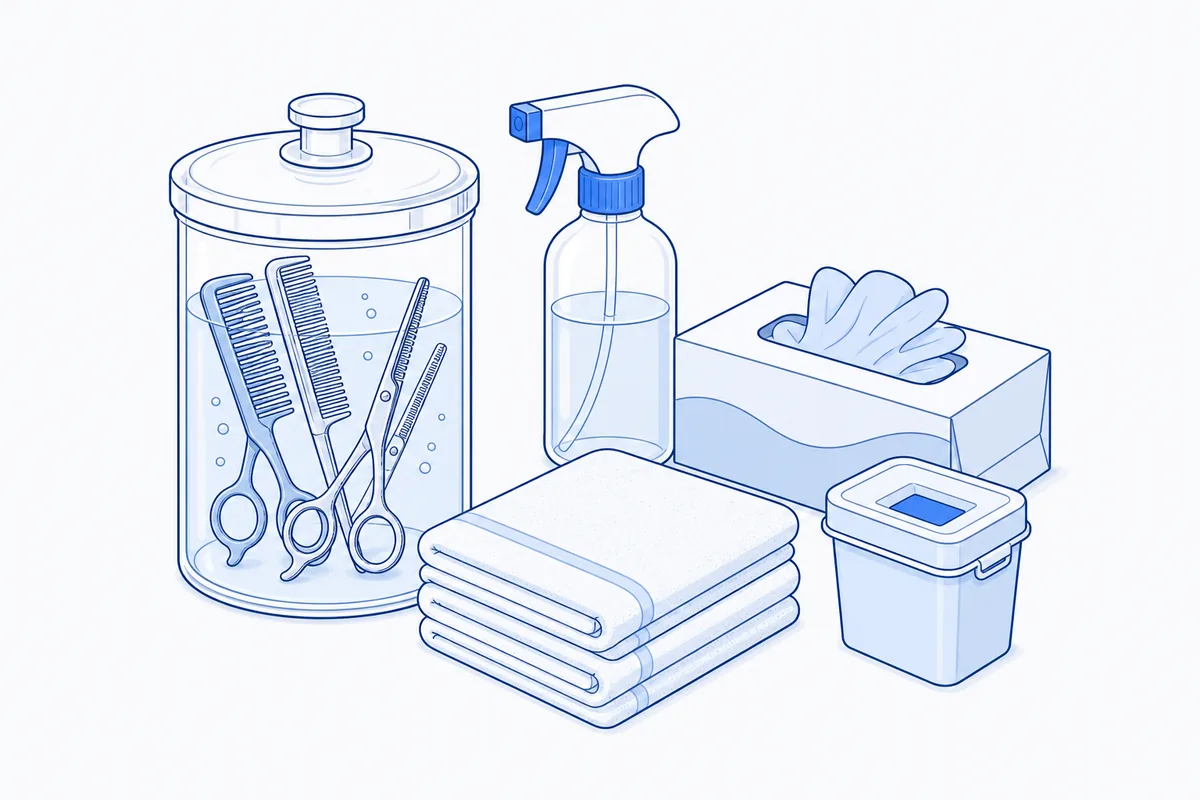
- Cleaning removes visible debris and is always done first. Disinfection kills most pathogens on nonporous surfaces. Sterilization, by autoclave, kills all microbial life including spores.
- Disinfectants must be EPA-registered and used exactly as the label directs. The surface must stay wet for the full contact time on the label.
- Porous single-use items (neck strips, cotton, paper, wooden sticks) are discarded after one client. Nonporous multi-use items are cleaned and disinfected between clients.
- Bacteria come as cocci (round: staphylococci in clusters, streptococci in chains, diplococci in pairs), bacilli (rods) and spirilla (spirals). Viruses reproduce only inside living cells.
- Standard Precautions treat all blood and body fluids as infectious. OSHA’s Bloodborne Pathogens Standard covers gloves, sharps containers and exposure control.
- In a blood exposure: stop the service, put on gloves, clean the wound, apply antiseptic or styptic with a single-use applicator, cover it, discard contaminated items, and disinfect implements before continuing.
- Safety Data Sheets, required by OSHA’s Hazard Communication Standard, describe each chemical’s hazards, handling, storage and first aid.
Start the free infection control drill · NIC barber theory mock exam
Drill infection control, then sit the full exam
60 questions in 90 minutes across all four NIC domains, with a score by topic and an explanation for every answer.
Or try the free infection control and safety drillCommon questions
What is the difference between disinfection and sterilization?
Disinfection destroys most harmful organisms on nonporous surfaces but not bacterial spores. Sterilization destroys all microbial life, including spores, usually with an autoclave.
What should a barber do if a client is cut?
Stop the service, put on gloves, clean the cut, apply an antiseptic or styptic with a single-use applicator, cover it, double-bag contaminated items and disinfect every implement that touched blood before continuing.
60 questions in 90 minutes across all four NIC domains, with a score by topic and an explanation for every answer.
Or try the free infection control and safety drillMore barber topics
- Anatomy and physiology
- Hair, scalp and skin disorders
- Barbering chemistry
- Implements, tools and equipment
- Consultation, shampoo and scalp care
- Haircutting and styling
- Hair color and chemical services
- Shaving and facial hair design
- Facials, massage and electrotherapy
- NIC Barber Theory Practice Test
- Texas Barber Practice Test
- California Barber Practice Test
- Florida Barber Practice Test
Domains and format: NIC: National Barber Theory Examination CIB (effective June 1, 2025) · NIC: National Barber Styling Theory Examination CIB (effective June 1, 2025), checked November 2026.
NIC exam names belong to the National-Interstate Council of State Boards of Cosmetology; PSI and Pearson VUE are trademarks of their owners. Original independent practice. Every question is written for practice to the published content outlines and the cited statutes and rules. Not affiliated with or endorsed by NIC, PSI, Pearson VUE, TDLR, the California Board of Barbering and Cosmetology, the Florida DBPR, the Florida Barbers’ Board or any state board.