AEMT practice test · 9–13% of the exam
AEMT Airway, Respiration and Ventilation
Airway, Respiration and Ventilation is 9–13% of the AEMT exam. The test plan samples assessment, pathophysiology and management, so a typical item gives you a breathing patient with vital signs, lung sounds and a capnography reading and asks what is wrong or what to do next.
135 questions in 3 hours, weighted to the six official domains, with a score report by domain and topic and an explanation for every answer.
Or start with a free domain drillWhich patient is the most appropriate candidate for a supraglottic airway placed by the AEMT?
What the Airway, Respiration and Ventilation domain tests
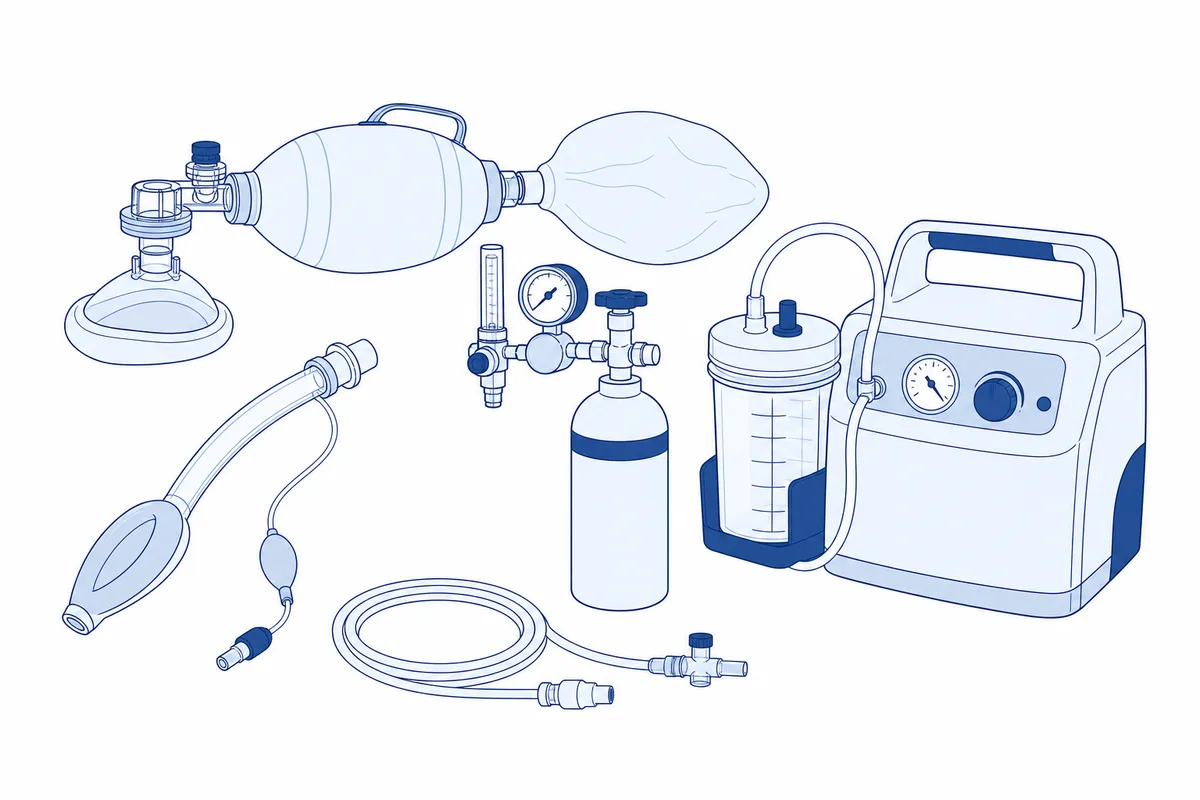
The AEMT airway ladder stops at the supraglottic airway: positioning and adjuncts, suction, two-person BVM, supraglottic placement and confirmation, CPAP, oxygen titration and capnography. Intubation, needle decompression and surgical airways are paramedic skills and appear only as wrong answers.
- Assessment: adequate versus inadequate breathing, work of breathing, lung sounds, pulse oximetry limits, capnography basics.
- Pathophysiology: asthma, COPD, pneumonia, pulmonary embolism, pulmonary edema, anaphylaxis, opioid respiratory depression, upper versus lower airway obstruction.
- Management: supraglottic airway indications, insertion and confirmation; two-person BVM; CPAP indications and contraindications; suction, including an intubated patient’s tube; oxygen devices and titration.
- Respiratory pharmacology: nebulized albuterol and ipratropium, IM epinephrine for anaphylaxis with airway involvement.
- Pediatric airway: anatomic differences, croup, epiglottitis, bronchiolitis, early respiratory failure, pediatric BVM.
- When to call for ALS: the airway you cannot secure, the patient who needs intubation or decompression.
In our 135-question practice exam this domain gets 15 questions, the middle of its official 9–13% range.
Know these cold
- Normal EtCO2 is 35–45 mmHg; a falling or absent waveform in a ventilated patient means check the airway and the circuit.
- Ventilate an adult with a supraglottic airway once every 6 seconds; avoid hyperventilation.
- Titrate oxygen to SpO2 94–98% for most patients and 88–92% for chronic CO2 retainers; pulse oximetry reads falsely normal in carbon monoxide poisoning.
- CPAP is for the awake, cooperative patient who can protect the airway, such as pulmonary edema or COPD exacerbation; not for apnea, vomiting, hypotension or facial trauma.
- Two-person BVM gives a better seal and tidal volume than one; squeeze only until the chest rises.
- Severe asthma: albuterol 2.5 mg and ipratropium 0.5 mg nebulized; epinephrine IM for the patient who cannot move air; call for ALS.
- Children have a larger occiput and tongue and a narrower airway: pad the shoulders, size adjuncts carefully and ventilate gently.
Common questions
Can an AEMT intubate?
Not under the National EMS Scope of Practice Model. AEMTs place supraglottic airways and use capnography to confirm and monitor them. Intubation, needle decompression and surgical airways belong to paramedics, so on the AEMT exam those actions are wrong answers and the right answer is often to request ALS while ventilating.
Does the AEMT exam test capnography?
Yes. Waveform capnography monitoring is an AEMT skill in the scope model, and the AEMT exam’s graphical items use capnography strips. Know the normal range of 35–45 mmHg, what a lost waveform means and how EtCO2 reflects CPR quality.
Ready for exam day?
135 questions in 3 hours, weighted to the six official domains, with a score report by domain and topic and an explanation for every answer.
Or start with a free domain drillThe other AEMT domains
- Cardiology and Resuscitation 11–15%
- Trauma 7–11%
- Medical, Obstetrics and Gynecology 25–29%
- EMS Operations 6–10%
- Clinical Judgment 31–35%
Domain weights and knowledge areas from the National Registry AEMT Examination Specifications (July 2024). National Registry: AEMT and Paramedic Certification Examinations · National Registry AEMT Examination Specifications (test plan).
Original independent practice questions. Not affiliated with or endorsed by the National Registry of Emergency Medical Technicians. Follow your local protocols and medical director in the field.