Praxis 5005 Earth Science

Content category I of the Elementary Education: Science Subtest (5005): about 17–18 of the 55 questions (33%). The topics ETS lists, how they are tested and practice questions with explanations.

55 questions on the real 60-minute clock, weighted like the ETS test, with a score by content category and an explanation for every answer.

Or start the free Earth Science drill

What ETS lists

  • The structure of the Earth system (solid Earth, hydrosphere, atmosphere)
  • Processes of the Earth system
  • Earth history (origin of Earth, paleontology, the rock record)
  • Earth and the universe (stars and galaxies, the solar system, Earth, Sun and Moon relationships)
  • Earth patterns, cycles and change
  • Science as a human endeavor, as inquiry, and its unifying processes

From the ETS Elementary Education: Science Subtest (5005) Study Companion, content category I.

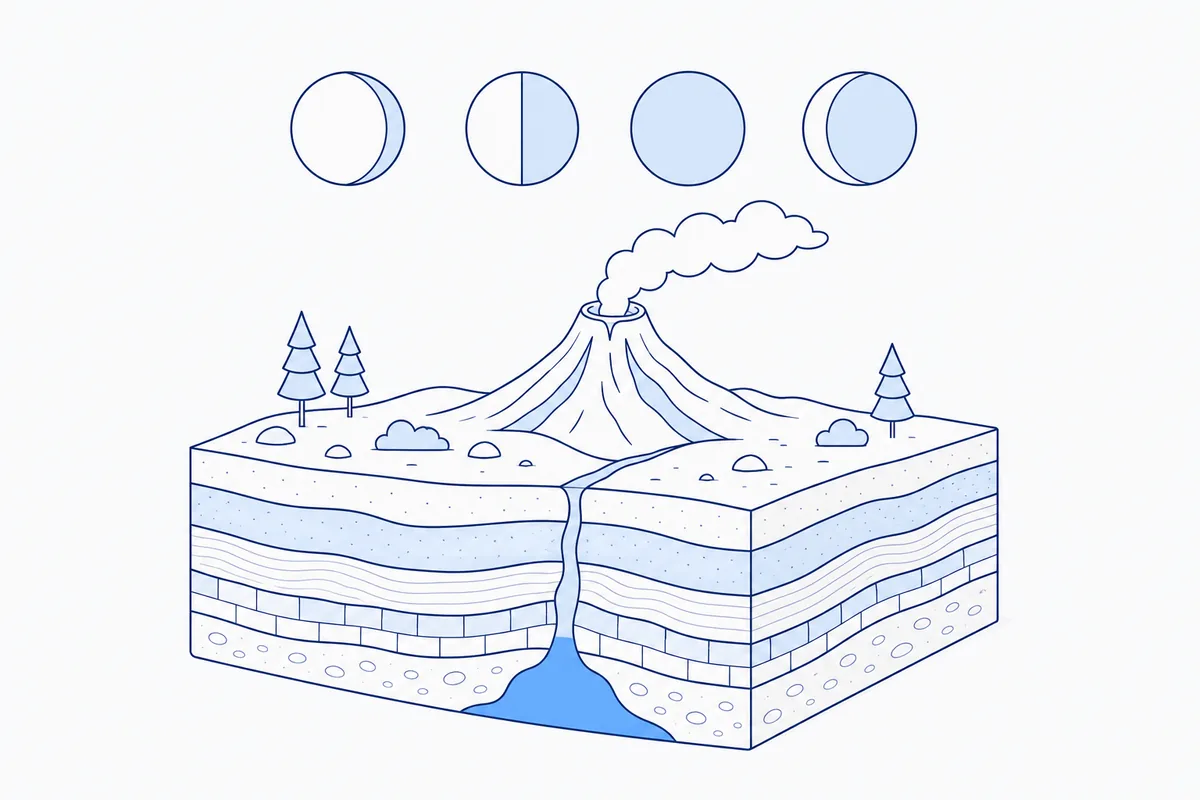
Line drawing of layered rock strata, a volcano and the phases of the Moon

How Earth Science is tested

Earth’s layers and plate tectonics, rocks, minerals and the rock cycle, weathering and erosion, the water cycle, weather and climate, fossils and geologic time, and the Sun, Moon, seasons, tides and solar system. Some questions are about scientific inquiry: controlled experiments, variables and conclusions from data.

Praxis 5005 Earth Science practice questions

Answer each question, then open the explanation.

Question 1

Layers of sand accumulate on a lake bottom. Which processes can turn these sediments into sandstone?

  1. A.Compaction and cementation
  2. B.Weathering and erosion
  3. C.Melting and rapid cooling
  4. D.Evaporation and condensation
Show the answer and explanation

Answer: A: Compaction and cementation

Compaction presses sediment grains together, and cementation binds them with deposited minerals. Melting and cooling form igneous rocks rather than sandstone.

Question 2

A class repeatedly measures the mass of the same dry rock. The balance gives similar readings, but each reading exceeds the mass found with a certified reference balance. What is the best next step?

  1. A.Check the balance with a known reference mass and calibrate it.
  2. B.Average more readings from the same uncalibrated balance.
  3. C.Report the similar readings as proof that the measurements are accurate.
  4. D.Choose the largest reading because it includes the most material.
Show the answer and explanation

Answer: A: Check the balance with a known reference mass and calibrate it.

Similar readings show repeatability, but a consistent difference from a reference indicates systematic error. Calibration addresses that error; simply averaging more readings does not remove it.

Question 3

Which gas makes up the largest portion of dry air near Earth’s surface?

  1. A.Hydrogen
  2. B.Oxygen
  3. C.Nitrogen
  4. D.Carbon dioxide
Show the answer and explanation

Answer: C: Nitrogen

Nitrogen is the most abundant gas in dry air near Earth’s surface. Oxygen is the next most abundant, while carbon dioxide is present in a much smaller proportion.

Question 4

Three undisturbed sedimentary layers lie horizontally. Layer R is at the bottom, S is in the middle, and T is at the top. Which conclusion follows from the law of superposition?

  1. A.Layer T was deposited before layers R and S.
  2. B.All three layers were deposited at the same instant.
  3. C.Layer R was deposited before layers S and T.
  4. D.Layer S must contain the largest sediment grains.
Show the answer and explanation

Answer: C: Layer R was deposited before layers S and T.

In an undisturbed sequence, each sedimentary layer is older than the layer above it. This establishes a relative age order but does not determine grain size or exact ages.

Take the full test under the real clock

55 questions on the real 60-minute clock, weighted like the ETS test, with a score by content category and an explanation for every answer.

Or start the free Earth Science drill

Common questions

How many Earth Science questions are on the Praxis 5005?

ETS lists about 17–18 of the 55 questions in Earth Science, about 33% of the test.

What does Earth Science cover on the Praxis 5005?

The structure of the Earth system (solid Earth, hydrosphere, atmosphere); Processes of the Earth system; Earth history (origin of Earth, paleontology, the rock record); Earth and the universe (stars and galaxies, the solar system, Earth, Sun and Moon relationships); Earth patterns, cycles and change; Science as a human endeavor, as inquiry, and its unifying processes.

How should I study Earth Science for the Praxis 5005?

Earth’s layers and plate tectonics, rocks, minerals and the rock cycle, weathering and erosion, the water cycle, weather and climate, fossils and geologic time, and the Sun, Moon, seasons, tides and solar system. Some questions are about scientific inquiry: controlled experiments, variables and conclusions from data.

Praxis is a registered trademark of ETS. Original independent practice questions written to the published ETS Study Companions; not affiliated with or endorsed by ETS.