Hazardous (classified) locations
Hazardous-location questions test the classification system first: what makes a location Class I, II or III, Division 1 or 2, and which group a material falls in. The wiring rules then follow from the classification.
A timed 100-question exam in the ICC R16 format on the 2023 NEC, or the two-part Texas exam. Every answer has a worked explanation and you get a score by topic.
Or start with the free hazardous (classified) locations drillClasses and divisions
Division 1 locations have the hazard present under normal operating conditions; Division 2 locations have it only under abnormal conditions, such as a container failure. Article 505 covers the Class I Zone 0, 1 and 2 system and Article 506 the Zone 20, 21 and 22 system for dusts and fibers.
| Class | Hazard | Groups |
|---|---|---|
| Class I | Flammable gases, flammable liquid-produced vapors, combustible liquid-produced vapors | A (acetylene), B (hydrogen), C (ethylene), D (propane, gasoline) |
| Class II | Combustible dust | E (metal dusts), F (carbonaceous dusts), G (other dusts such as grain and flour) |
| Class III | Ignitible fibers or flyings | No groups |
Seals and wiring in Class I locations
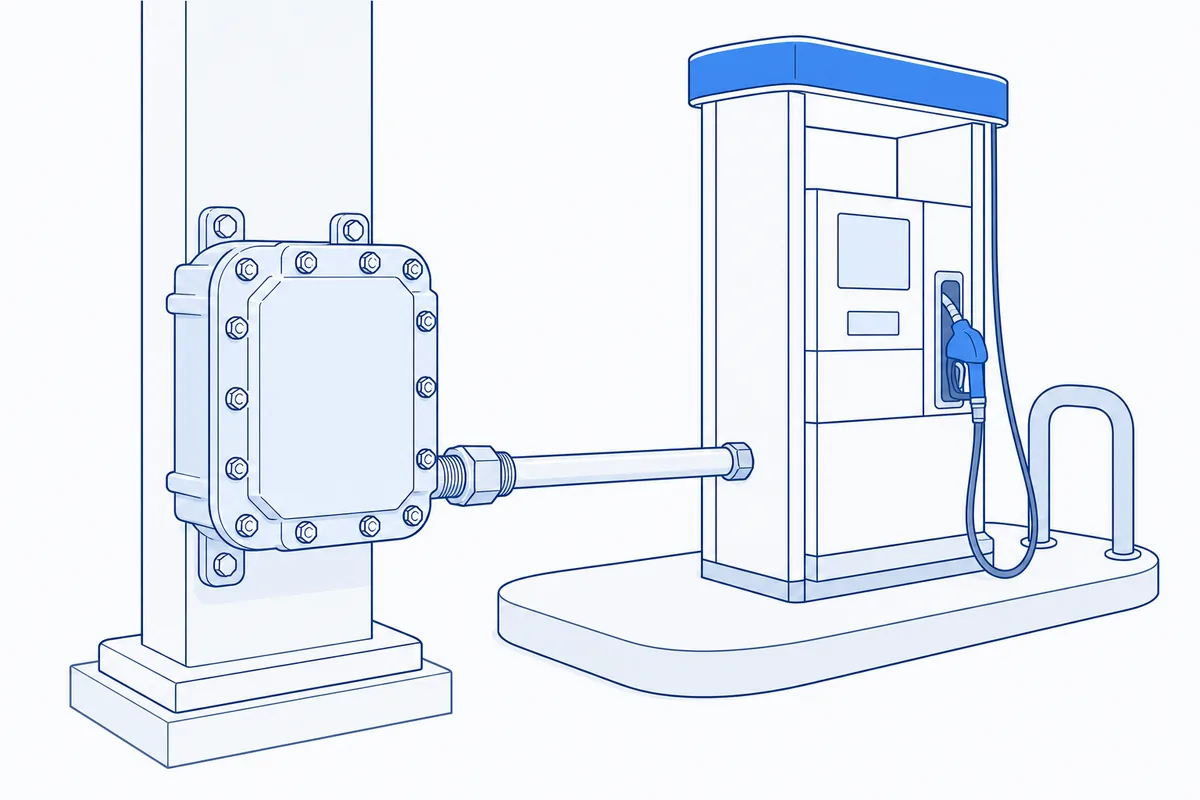
- In Class I, Division 1, a conduit seal goes within 18 in. of an enclosure that contains arcing or high-temperature parts (501.15(A)(1)).
- The cross-sectional area of conductors in a seal may not exceed 25% of the area of rigid metal conduit of the same trade size, unless the seal is listed for more (501.15(C)(6)).
- Threaded conduit joints need at least five full threads made up wrenchtight (500.8(E)).
Common occupancies
- Repair garages: the classified area at the floor extends up to 18 in. above the floor, and mechanical ventilation can reduce or remove the classification (511.3).
- Motor fuel dispensing: the space up to 18 in. above grade within 20 ft horizontally of a dispenser enclosure is Class I, Division 2 (Table 514.3(B)(1)).
- Spray application areas: Article 516 classifies the interior of spray booths and the space around open spraying.
Common questions
What is the difference between Division 1 and Division 2?
In Division 1 the flammable gas, vapor or dust is present under normal operation. In Division 2 it is present only under abnormal conditions, such as a leak or equipment failure.
Which group is gasoline?
Group D, together with propane and similar gases.
How close to the enclosure must a Division 1 conduit seal be?
Within 18 in. of the enclosure (501.15(A)(1)).
Practice hazardous location questions
A timed 100-question exam in the ICC R16 format on the 2023 NEC, or the two-part Texas exam. Every answer has a worked explanation and you get a score by topic.
Or start with the free hazardous (classified) locations drillMore master exam guides
- Master electrician load calculations
- Services, feeders and transformers
- Grounding and bonding for the master exam
- Motor calculations (Article 430)
- Special occupancies and emergency systems
- Master electrician practice test
- ICC Master Electrician Practice Test (R16)
- Texas Master Electrician Practice Test (TDLR)
Section numbers follow the 2023 National Electrical Code (NFPA 70); rules are paraphrased, not quoted. Independent preparation, not affiliated with NFPA, ICC, PSI, Pearson VUE or any state board.