NCLEX-RN Basic Care and Comfort
6–12% of the NCLEX-RN · Physiological Integrity
85 questions weighted to every client-needs category, three case studies, and a score for Basic Care and Comfort so you know where you stand.
Free Basic Care and Comfort drillA nurse is giving a bed bath to a client in a semi-private room. The client had a bowel movement and is embarrassed. Which action best maintains dignity?
Basic Care and Comfort on the 2026 test plan
Basic Care and Comfort is 6–12% of the exam and covers the hands-on care that keeps clients safe and comfortable: nutrition, elimination, mobility, skin, sleep, pain and hygiene. The questions test correct technique and the order of steps.
- Share of the exam
- 6–12% of scored stand-alone items (we weight our mock exams at 9%)
- Client Needs category
- Physiological Integrity
- Our drill
- 10 questions, untimed, a rationale for every option; one free attempt, unlimited with a pass
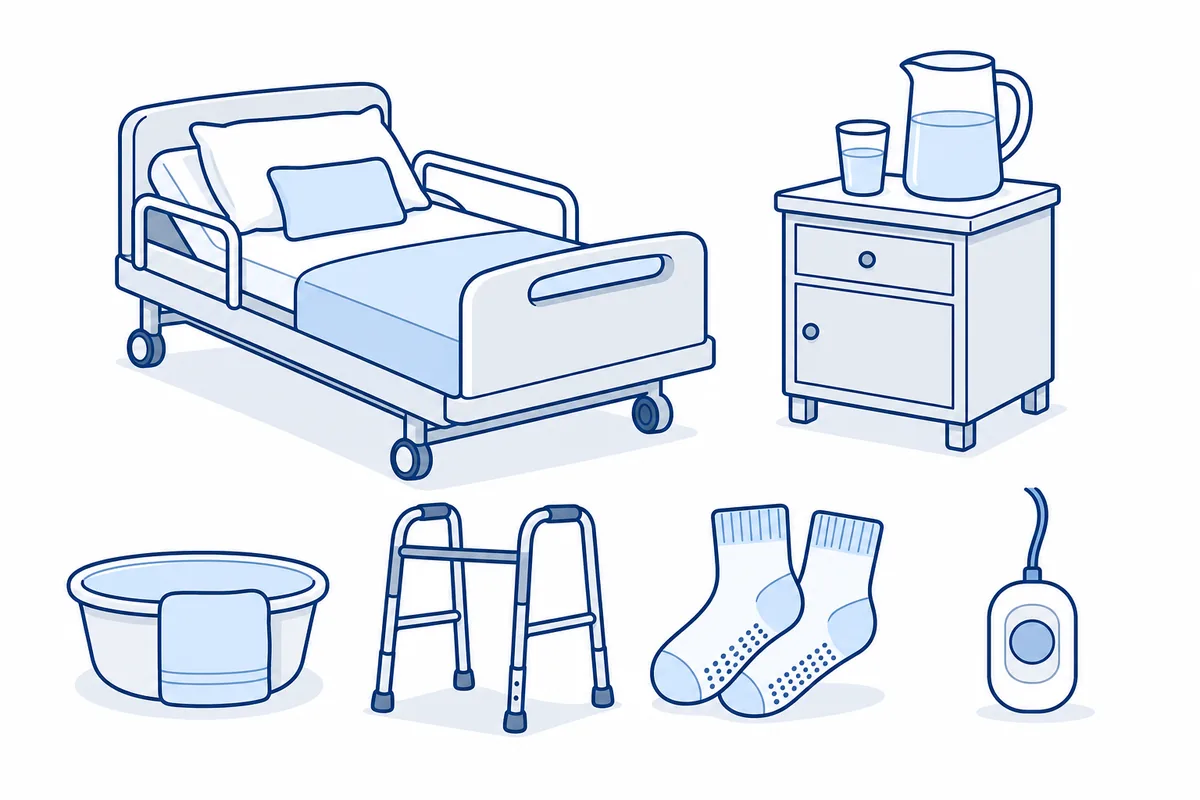
What Basic Care and Comfort questions test
- Assessing and assisting with activities of daily living while keeping dignity and privacy
- Nutrition: therapeutic diets, dysphagia and aspiration precautions, tube feedings and intake and output
- Elimination: constipation, diarrhea, incontinence, retention, catheter care and ostomy care
- Mobility and assistive devices: canes, walkers, crutches, transfers and positioning after surgery
- Skin assessment, pressure injury staging and prevention, and wound care basics
- Orthopedic devices: casts, traction and splints, and the neurovascular check
- Pain assessment across ages, including nonverbal clients, and nonpharmacological comfort measures
- Sleep and rest, irrigations, postmortem care and complementary therapies
Sit the full exam under the real clock
85 questions weighted to every client-needs category, three case studies, and a score for Basic Care and Comfort so you know where you stand.
Free Basic Care and Comfort drillHow to study it
- Mobility aids have fixed rules: cane on the strong side moving with the weak leg; up stairs with the good leg first, down with the bad leg first.
- Pressure injuries are staged by the deepest tissue visible; know what makes stage 1, 2, 3, 4, unstageable and deep tissue injury.
- For tube feedings, verify placement, keep the head of the bed up and flush before and after; check the facility rule for residual volumes.
- A neurovascular check covers color, temperature, capillary refill, pulses, sensation and movement; pain out of proportion is the earliest sign of compartment syndrome.
Common questions
Which side does a client hold a cane on?
On the strong, unaffected side. The cane moves forward with the weak leg so the body weight is shared between the cane and the stronger leg. On stairs the strong leg leads up and the weak leg leads down.
What is a stage 2 pressure injury?
Partial-thickness skin loss with exposed pink or red moist dermis, or an intact or ruptured serum-filled blister. No slough, granulation tissue or deeper structures are visible. Stage 1 is intact skin with non-blanchable redness; stage 3 reaches fat.
How does a nurse assess pain in a client who cannot speak?
With a behavioral tool matched to the client: FLACC for infants and young children, PAINAD for advanced dementia. The nurse watches facial expression, body movement, muscle tension, breathing and consolability, and treats pain when behavior suggests it.
85 questions weighted to every client-needs category, three case studies, and a score for Basic Care and Comfort so you know where you stand.
Free Basic Care and Comfort drillMore NCLEX-RN guides
- NCLEX-RN Management of Care
- NCLEX-RN Safety and Infection Prevention and Control
- NCLEX-RN Health Promotion and Maintenance
- NCLEX-RN Psychosocial Integrity
- NCLEX-RN Pharmacological and Parenteral Therapies
- NCLEX-RN Reduction of Risk Potential
- NCLEX-RN Physiological Adaptation
- NCLEX-RN for internationally educated nurses
- Retaking the NCLEX-RN
- NCLEX-RN practice exam (85 items)
Sources
- NCSBN: 2026 NCLEX-RN Test Plan (effective April 1, 2026)
- NCLEX.com: Test plans
- NCSBN: NCLEX Candidate Bulletin (October 2025): fees, retake policy, exam length and time
- NCSBN: NCLEX registration fee change effective February 1, 2027
- NCSBN: 2025 NCLEX Examination Statistics (volumes and pass rates)
- NCLEX.com FAQs: partial-credit scoring (plus/minus, zero/one, rationale)
- NCSBN: Candidate Performance Report
Original practice questions for exam preparation, written to the 2026 NCLEX-RN Test Plan. Independent practice, not affiliated with or endorsed by the National Council of State Boards of Nursing (NCSBN) or Pearson VUE. NCLEX and NCLEX-RN are registered trademarks of NCSBN.