pymetrics Keypresses Game: Complete Practice Guide | Game Assessment Prep
By the Game Assessment Prep research teamUpdated July 15, 2026How we research
What is the pymetrics Keypresses game?
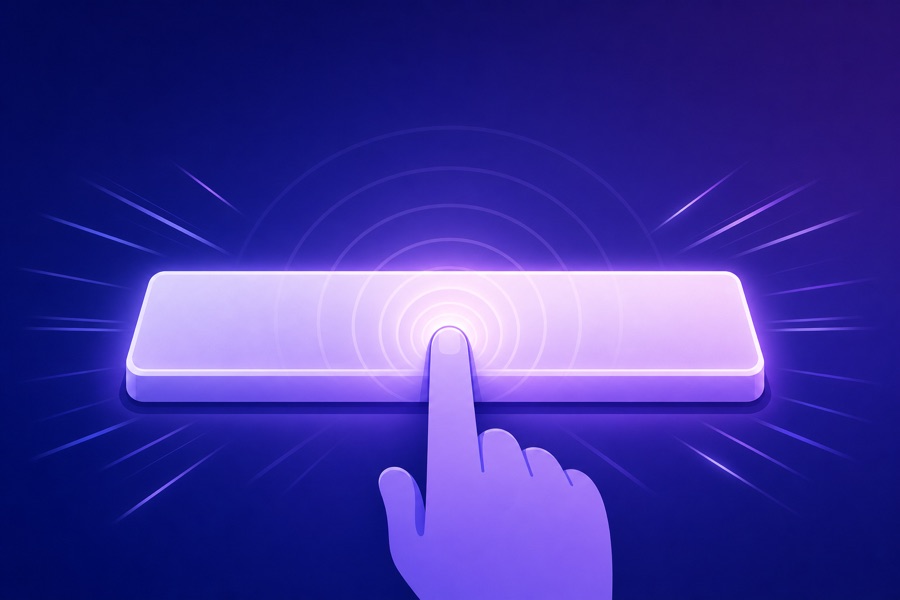
Keypresses is the most mechanically direct game in the pymetrics battery. You wait for a GO cue, press the spacebar as rapidly as possible during a fixed window, and stop when STOP appears. The count is hidden while you play and revealed only after our practice round.
The apparent simplicity is intentional. Finger-tapping tasks have a long history in neuropsychological testing, and pymetrics adds start/stop cueing so the task can observe both motor speed and response control. A fast total is only part of the behavior. Pressing before GO or continuing after STOP can reveal that speed came at the expense of following the rule.
You are normally instructed to use the dominant-hand index finger. A browser cannot verify which finger or hand you use, and neither can a faithful web reconstruction. Alternating two hands may inflate a raw count, but it means you are no longer practicing the instructed task.
What does Keypresses measure?
The primary skill-like measure is tapping rate: valid taps divided by the GO-window duration. That reflects a mixture of motor speed, processing speed, rhythm, hardware, and technique. Because the interval is fixed, total valid taps and taps per second rank players in the same order within one configuration.
The second signal is instruction-following or impulse control. A premature press means you acted before the explicit start cue. A post-STOP press means the motor pattern continued after the rule changed. One late press may simply reflect ordinary reaction time, while a longer run of late presses is a clearer failure to disengage. Our completion screen describes what happened without labeling you impulsive from one short practice session.
Keypresses is classified as a skill game because tapping rate can be measured and compared. The compliance observations still require cautious interpretation. We do not know pymetrics' production feature weights, role models, or thresholds, and no guide can tell you a tap count that guarantees success.
Parameters we know—and what remains uncertain
The spacebar mapping is high-confidence. The patent family identifies a finger-tapping task, and detailed preparation accounts consistently describe spacebar input on desktop. The GO/STOP structure and the relevance of early and late presses are also well supported.
Duration is the biggest uncertainty. Public claims range from roughly 10–20 seconds to 40 or 60 seconds, and no first-hand capture of the gated production platform settles the question. We ship a 15-second GO window because it sits inside the most repeated range and resembles conventional short finger-tapping intervals. The value lives in a configuration object so it can be corrected without rewriting the engine.
The number of GO/STOP cycles is also undocumented. Some descriptions imply one interval; others suggest repeated cueing. Our default is one cycle. Before it, a two-second READY period creates an observable premature-press window. After STOP, a short observation period lets the engine record continued taps before completing the session.
The live counter is deliberately hidden. Showing a changing number can alter pacing, encourage threshold chasing, and make the practice less faithful. The interval countdown is hidden for the same reason: the real screen shows a GO cue and then a STOP or loading screen with no timer, so you practice stopping on the cue rather than on a clock. Coaching metrics wait until completion.
Six practical strategies
1. Follow the instructed technique
Place your dominant-hand index finger comfortably over the center of the spacebar. Keep your wrist neutral and your other fingers relaxed. The goal is a repeatable, legitimate technique—not discovering a browser exploit that will not represent how you intend to take the assessment.
2. Start from stillness
Do not preload a downward press while READY is visible. Rest lightly enough that you can respond to GO without accidentally actuating the key. A clean start is worth more than gambling on a tiny anticipatory advantage.
3. Use a small, even motion
Large finger lifts waste distance. Let the key return fully, then press again with a compact movement. If presses stop registering, you may be moving so shallowly that the keyboard is not resetting between taps.
4. Build rhythm after GO
The first few taps establish cadence. Focus on an even cycle rather than trying to accelerate throughout the interval. Erratic bursts often produce tension, missed actuations, and a larger overrun when STOP appears.
5. Watch the cue, not the hidden count
Keep your eyes on the GO/STOP area. Do not look down at your hand once the interval begins. The task asks you to terminate a repetitive action from a visual instruction, so monitoring the cue is part of the challenge.
6. Stop as a deliberate action
Prepare mentally for STOP before it arrives. When it appears, lift your finger and hold it visibly clear of the key. Thinking “lift” is more actionable than vaguely trying not to press. If you overrun in practice, train the stop response rather than only chasing a higher rate.
How to read your practice result
Total taps counts valid presses made during GO. Taps per second normalizes that count by the configured interval. Clean start and stop is marked only when there were no recorded presses before GO or after STOP. The trial log also keeps every tap timestamp, source, phase, and reaction time so the result can explain an overrun instead of reducing everything to one number.
Once at least 100 comparable sessions exist, the practice percentile ranks the scaled taps-per-second metric used by this site. It is not a published pymetrics norm. Keyboard travel, browser performance, injury, device choice, and touch input all affect tapping, so compare sessions made under similar conditions.
Keypresses FAQ
Can I use two fingers or two hands?
The software can count those presses, but the reported instruction is dominant-hand index finger. Using another technique may create a larger number while making your practice less representative. Follow the rule you expect to receive.
Why is there no live counter?
The faithful version hides it because feedback changes behavior. A visible counter can make you sprint toward a target, slow down after reaching it, or trade clean stopping for one more tap.
Does one late press mean I failed?
No universal pass mark exists, and one action should not be overinterpreted. Use the timestamp to see how quickly you disengaged, then practice making STOP trigger a clear lift.
Is mobile practice equivalent?
No. A full-width tap target makes the game usable on touch devices, but touchscreens and physical spacebars have different travel, latency, and tactile feedback. The real assessment is best taken on a computer with a keyboard; practice there at least once.
How much can I improve?
You can improve posture, rhythm, cue attention, and familiarity fairly quickly. Raw motor speed has individual limits, and excessive drilling can cause fatigue. Short, rested attempts are safer and more informative than repeated all-out tapping.
Continue your pymetrics preparation
Review the complete guide library for game mechanics, transparent practice metrics, and focused strategies across the full battery.
Browse pymetrics guides